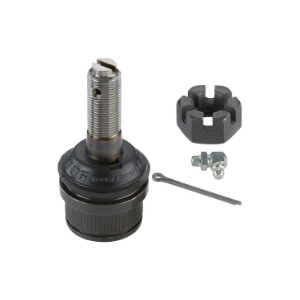
Have you ever noticed unusual steering issues, uneven tire wear, or strange clunking noises while driving your Silverado? If so, have you considered that worn ball joints could be the culprit?
Ball joints play a critical role in your Silverado’s suspension and steering system, yet they’re often overlooked until serious problems arise. Ignoring damaged ball joints can lead to poor vehicle handling, costly repairs, and even dangerous road accidents.
If you’re searching for how to check ball joints Silverado, you’re already taking an important step toward keeping your truck safe and roadworthy. The good news is that inspecting ball joints isn’t as complicated as it may seem. With a few simple checks, you can identify potential wear before it turns into a major safety concern.
So, how can you tell if your Silverado’s ball joints are in good condition? Let’s walk through the inspection process and help you keep your truck running smoothly and safely.
How to check ball joints Silverado 2026
Table of Contents
Method 1
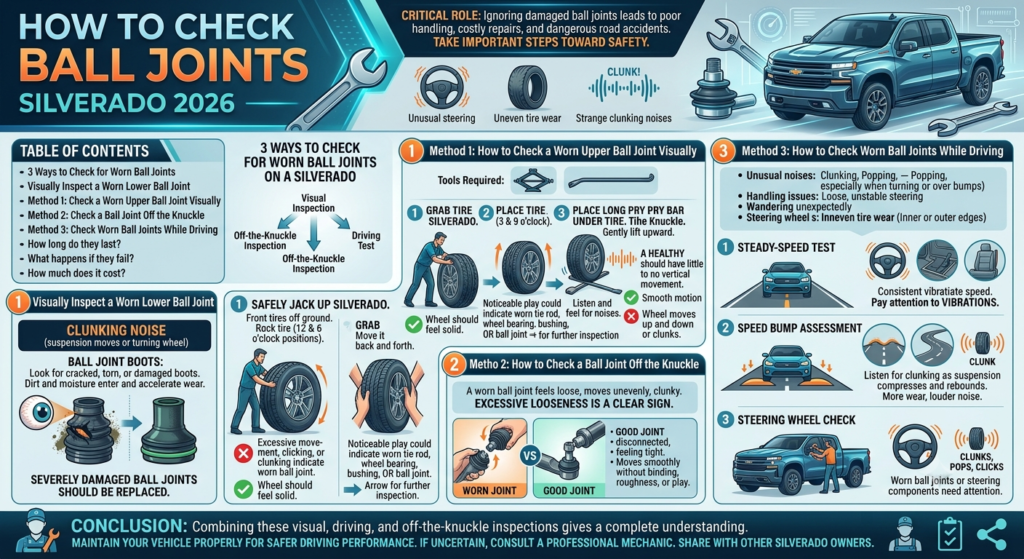
3 Ways to Check for Worn Ball Joints on a Silverado
There are three effective ways to check whether the ball joints on your Silverado are worn out:
- Visual inspection
- Off-the-knuckle inspection
- Driving test
Let’s start with a visual inspection.
How to Visually Inspect a Worn Lower Ball Joint
A worn lower ball joint often produces a clunking noise when the suspension moves or when you turn the steering wheel. As the ball joint continues to wear, the noise usually becomes louder and more noticeable.
To visually inspect your Silverado’s ball joints, examine the upper portion of the wheel assembly. Look closely at the ball joint boots. If you notice cracked, torn, or damaged boots, dirt and moisture can enter the joint and accelerate wear. In some cases, regreasing the ball joint may help, but severely damaged ball joints should be replaced.
Method 1: How to Check a Worn Upper Ball Joint Visually
Tools Required
- Jack
- Long pry bar
Step 1
Safely jack up the Silverado until both front tires are off the ground. Grasp the tire at the 12 o’clock and 6 o’clock positions and rock it inward and outward.
If you feel excessive movement, clicking, or clunking, there may be a worn ball joint. The wheel should feel solid with minimal play.
Step 2
Next, grab the tire at the 3 o’clock and 9 o’clock positions and move it back and forth.
Any noticeable play could indicate a worn tie rod, wheel bearing, bushing, or ball joint. Further inspection may be required to identify the exact cause.
Step 3
Place a long pry bar underneath the tire and gently lift upward.
Listen and feel for any clicking or clunking noises. Excessive movement or a distinct clunk may indicate a worn ball joint.
Step 4
A healthy ball joint should have little to no vertical movement. If the wheel moves up and down or produces a clunking sound during testing, the ball joint is likely worn and should be inspected further.
Method 2: How to Check a Ball Joint Off the Knuckle
Removing the ball joint from the steering knuckle allows for a more accurate inspection.
A worn ball joint will feel loose and may move unevenly or produce a clunky sensation when manipulated by hand. Excessive looseness is a clear sign that the ball joint has worn out.
In contrast, a good ball joint should feel tight and move smoothly through its range of motion without binding, roughness, or excessive play.
Method 3: How to Check Worn Ball Joints While Driving
While driving, pay attention to unusual noises and handling characteristics.
Worn ball joints can cause clunking or popping sounds, especially when turning or driving over bumps. You may also notice steering wheel vibrations or the vehicle pulling to one side.
Monitor how your Silverado handles on the road. If the steering feels loose, unstable, or wanders unexpectedly, worn ball joints could be the cause.
Uneven tire wear, particularly along the inner or outer edges, is another common symptom of failing ball joints.
If you experience any of these signs, have your Silverado inspected by a qualified mechanic. A professional diagnosis can confirm whether the ball joints need replacement.
Regular inspections and maintenance can help identify ball joint issues early, preventing more expensive suspension repairs and improving overall driving safety.
Step 1: Steady-Speed Test
Drive your Silverado at a consistent, moderate speed on a smooth road.
Pay close attention to any vibrations felt through the steering wheel, floorboard, or seat. Excessive vibrations can be a sign of worn ball joints or other suspension issues.
If these vibrations occur consistently, it’s worth inspecting the ball joints more closely.
Step 2: Speed Bump Assessment
Next, drive slowly over a few speed bumps and make several gentle turns.
Listen carefully for any clunking noises coming from the suspension. Worn ball joints often create a noticeable clunk when the suspension compresses and rebounds.
Generally, the more severe the wear, the louder and more frequent the noise will be.
Step 3: Steering Wheel Check
While the vehicle is parked, turn the steering wheel from side to side several times.
Listen for unusual noises such as clunks, pops, or clicks. These sounds may indicate worn ball joints or other steering and suspension components that require attention.
If you hear persistent noise during this test, inspect the ball joints and related components as soon as possible.
Conclusion
We’ve now covered three practical ways to check your Silverado’s ball joints. These methods can help you assess the condition of your ball joints without requiring specialized tools.
By combining these driving tests with the visual and off-the-knuckle inspections discussed earlier, you’ll gain a more complete understanding of your Silverado’s ball joint condition. This knowledge can help you maintain your vehicle properly and ensure safer driving performance.
If you found this guide on how to check ball joints on a Silverado helpful, consider sharing it with other Silverado owners. Regular ball joint inspections can help prevent more serious suspension and steering issues, potentially saving you time and money on costly repairs.
Remember, if you’re uncertain about any of these tests or suspect a problem with your ball joints, it’s always best to consult a professional mechanic. A qualified technician can perform a thorough inspection, provide an accurate diagnosis, and recommend the appropriate repairs to keep your Silverado running safely and smoothly.
How long do Silverado ball joints last?
Maximum ball joint will last for 100,000 miles or more. If you do harsh driving then the durability of the ball joint will reduce.
What happens if ball joints fail while driving?
If the ball joint fails while driving then it can even result in the wheel dramatically falling off the car.
How much does it cost to replace all 4 ball joints?
The cost of replacing ball joint will vary from $100 to $200 if you do it by yourselves. If you select a higher priced ball joint then the cost of replacing ball joint will be more than $100 and if you select a budget friendly ball joint then the task of replacing the ball joint will be less than $100.