Have you ever felt frustrated by weak bass, muddy vocals, or unbalanced sound while driving?
Wondering why your car audio system doesn’t sound as clear and powerful as it should? The answer may lie in your crossover settings.
Learning how to set crossover frequency for car audio system components can make a huge difference in overall sound quality by directing the right frequencies to the right speakers.
Whether you’re using factory-installed speakers or an upgraded setup, proper crossover tuning helps deliver cleaner highs, richer mids, and deeper bass.
In this guide, you’ll discover the best crossover settings and simple tips to get the most from your car audio system.
What is frequency?
In physics, frequency refers to the number of oscillations or cycles a wave completes within a given period of time. It is typically measured in Hertz (Hz), where one Hertz equals one cycle per second. Simply put, frequency describes how often a wave repeats. The formula for frequency is:
f = 1/T
where f is the frequency and T is the period of the wave.
What is Crossover Frequency?
In simple terms, crossover frequency is the point at which an audio signal is divided and sent to different speakers within a sound system. For example, it determines where the sound transitions from the main speakers to the subwoofer.
A crossover acts as a filter, directing specific frequency ranges to the speakers best designed to reproduce them. High frequencies are sent to tweeters, low frequencies to subwoofers, and midrange frequencies to midrange speakers. This allows each speaker to focus on the sounds it handles most effectively, resulting in clearer, more balanced audio.
In passive audio systems, the crossover uses built-in electronic components to route frequencies to the appropriate speakers, improving overall sound quality and performance.
How to Set the Crossover Frequency for Your Car Audio System
Table of Contents
1. Determine Your Speaker’s Frequency Range
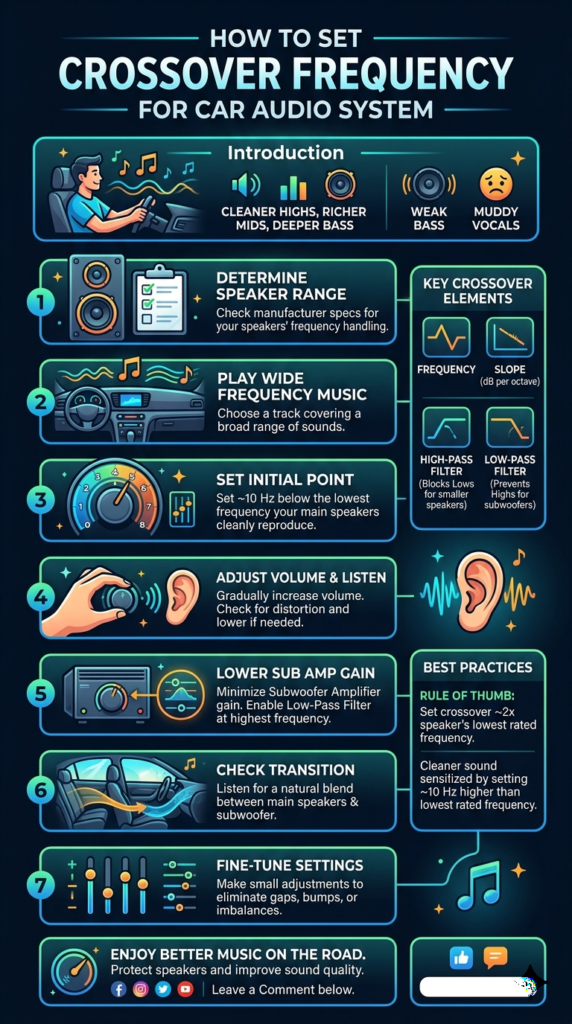
Start by identifying the frequency range your car speakers can handle. Since this range varies depending on the speaker type, check the manufacturer’s specifications for accurate information.
2. Play Music with a Wide Frequency Range
Choose a track that contains a broad range of frequencies. This will help you identify the ideal crossover frequency more accurately. As the music plays, listen carefully to how different frequencies are reproduced.
3. Set the Initial Crossover Point
Begin by setting the crossover frequency approximately 10 Hz below the lowest frequency your main speakers can reproduce cleanly. For example, if your speakers can handle frequencies down to 60 Hz, set the crossover to around 50 Hz.
4. Adjust the Volume and Listen for Distortion
Gradually increase the volume while listening closely. If you hear distortion, lower the volume slightly until the sound becomes clear. Make a note of this setting, as it will help during further adjustments.
5. Lower the Gain on the Subwoofer Amplifier
Turn the gain control on your subwoofer amplifier down to its minimum setting. Then, enable the low-pass filter and set it to its highest available frequency.
6. Play Music and Check for a Smooth Transition
Play your music again and listen for a seamless transition between the main speakers and the subwoofer. The bass should blend naturally with the rest of the audio without sounding disconnected or overpowering.
7. Fine-Tune the Crossover Frequency and Volume
If you notice a bass “bump,” gap, or imbalance in the sound, make small adjustments to the crossover frequency and volume levels until the bass integrates smoothly with the main speakers.
By following these steps, you can significantly improve your car audio system’s performance, resulting in clearer highs, richer mids, and well-balanced bass for a more enjoyable listening experience.
What Is Frequency?
In physics, frequency is defined as the number of oscillations or cycles of a periodic wave that pass through a fixed point in one unit of time. It is measured in Hertz (Hz).
Formula for Frequency:
f = 1/T
where:
- f = frequency (Hz)
- T = period of the wave (seconds)
The period represents the time required for one complete cycle of the sound wave.
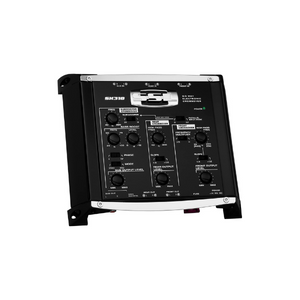
How to set crossover frequency for speakers
To set the crossover frequency correctly, it’s important to understand your audio equipment’s specifications, especially the frequency response range of your speakers. Follow these steps to achieve the best possible sound quality.
1. Check Your Speaker’s Frequency Response
Start by reviewing your speaker’s frequency response specifications. You may see a range such as 32 Hz–10,000 Hz, which indicates the lowest and highest frequencies the speaker can reproduce effectively.
2. Access the Receiver’s Setup Menu
Using your receiver’s remote control, open the setup menu and locate the speaker configuration settings. Here, you should find options to set the speaker size and adjust the crossover frequency. Since menu layouts vary by model, consult your receiver’s user manual if needed.
3. Note the Lowest Frequency Rating
Refer to your speaker’s frequency response and identify the lowest frequency it can handle. Most car speakers can reproduce frequencies between 30 Hz and 55 Hz, while subwoofers are often capable of reaching as low as 20 Hz.
4. Set the Crossover Frequency
Navigate to the crossover settings menu and adjust the high-pass crossover frequency. A commonly recommended guideline is to set the crossover frequency at approximately twice the speaker’s lowest rated frequency. For example, if your speaker’s lowest frequency is 40 Hz, set the crossover point to around 80 Hz.
5. Understand High-Pass and Low-Pass Crossover Settings
- High-pass crossover: Determines the frequency at which the main speakers stop reproducing lower frequencies, allowing those frequencies to be handled by the subwoofer.
- Low-pass crossover: Determines the highest frequency the subwoofer will reproduce, ensuring a smooth transition between the subwoofer and the main speakers.
6. Fine-Tune for a Seamless Sound Experience
Although many car speakers can reproduce frequencies as low as 40 Hz, setting the crossover approximately 10 Hz higher often results in a cleaner and more natural sound transition. Make small adjustments as needed until the audio sounds balanced, with no noticeable gaps, distortion, or excessive bass.
By following these steps, you can optimize your crossover settings and ensure that each speaker operates within its ideal frequency range. The result is a clearer, fuller, and more distortion-free listening experience.
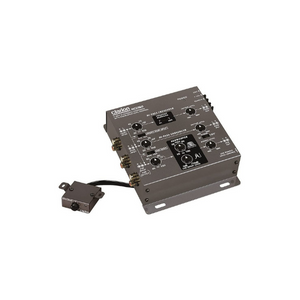
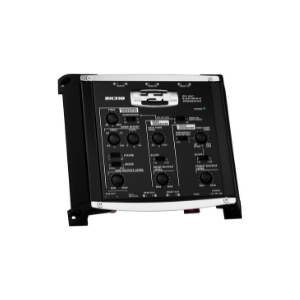
Choosing the Best Car Audio Crossover
If you’re looking to get the best sound from your car audio system, investing in a quality crossover is essential. A properly configured crossover can significantly improve sound quality, helping even average speakers deliver clearer, more balanced audio across the entire frequency range.
Key Elements of a Crossover System
When setting up a crossover, there are four key factors that influence sound quality: frequency, slope, high-pass filters, and low-pass filters. Understanding each of these settings will help you fine-tune your system for optimal performance.
Frequency
The crossover frequency determines where the audio signal is divided between different speakers. For example, it specifies the point at which low frequencies are sent to the subwoofer and higher frequencies are directed to the main speakers or tweeters.
Slope
The slope refers to how quickly frequencies are reduced beyond the crossover point. It is measured in decibels (dB) per octave. Steeper slopes provide a sharper cutoff between speakers, while gentler slopes allow for a smoother overlap of frequencies.
High-Pass Filter
A high-pass filter blocks low frequencies from reaching smaller speakers that are not designed to reproduce bass. This allows them to focus on midrange and high-frequency sounds, improving clarity and reducing distortion.
Low-Pass Filter
A low-pass filter prevents high frequencies from reaching the subwoofer, ensuring it reproduces only deep bass frequencies for a cleaner and more controlled low-end response.
For those who spend a significant amount of time driving—especially professional drivers—understanding how to adjust these crossover settings can greatly enhance the listening experience. By following the crossover frequency guidelines discussed earlier, you can optimize each component of your audio system for the best possible performance.
Enjoy Better Music on the Road
A quality car audio crossover not only protects your speakers from handling frequencies they aren’t designed for but also improves overall sound quality. With properly adjusted crossover settings, even a standard car audio system can deliver impressive clarity, balance, and depth.
Conclusion
By now, you should have a clear understanding of how to set the crossover frequency for your car audio system. Proper crossover settings help each speaker operate within its ideal frequency range, resulting in cleaner sound, improved bass response, and reduced distortion.
If you have any questions or would like to share your experience, feel free to leave a comment below. Enjoy your upgraded car audio experience and make every drive more enjoyable with better sound quality.